 Botswana
Botswana's Kalahari desert is home to one of the Africa's most unique cultures, the resourceful bushmen who have lived there for thousands of years. More of a plain than a desert, the Kalahari is an optimum safari region.  Cote d'Ivoire
Cote d'Ivoire, more off the beaten path, is especially renowned for its Senoufo and Dan people, both of which produce some of Africa's finest craft work.  Ghana
Ghana
The seat of the powerful Ashanti empire and the cornerstone of the gold, slave, and ivory trade, Ghana was especially coveted for years by imperial Europe, and every country with a navy seems to have left a fort behind. Cote d'Ivoire, more off the beaten path, is especially renowned for its Senoufo and Dan people, both of which produce some of Africa's finest craft work.  Kenya
Kenya
The queen of safari, Kenya is by far the most popular safari destination in the world. Its national parks are as exceptional as their reputations, and the Maasai Mara marks the beginning of the immense serengeti, known for its cats and colossal herds of migrating wildebeest. Kenya also blesses trekkers with the continent's second highest mountain, Mt. Kenya. 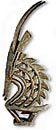 Mali
Mali
Timbuktu, the legendary city on the banks of the Niger River, rose up on the gold and ivory trade, and it was once the richest city in Africa. Today, an especially attractive aspect of Mali is its cultural wealth, which is perhaps most visible in the masterful artwork of its native people, the Dogon.  Morocco
A trekker's paradise with four magnificent ranges of the Atlas mountains, Morocco also harbors the urban adventures of Fes and Marakesh, cities that entrance the soul with their serpentine alleyways and arabesque skylines. 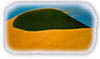 Namibia
Namibia, with its grand coastal desert and Kaoko Veld, is a land of breathtaking landscapes. In the north of the country is the famous birdwatcher's mecca, Etosha National Park.  Sinai
Sinai
Its Biblical sites have drawn spiritual pilgrims through the wadis and the waters of the Sinai Peninsula for nearly 2,000 years, but Sinai today is anything but the barren prison it was for Moses and the Isrealites. For scuba divers, in fact, the coral reefs of the Red Sea are an absolute paradise.  South Africa
For those who wish to safari in style, South Africa has some marvelously developed parks. The Kalahari Gemsbrook and Kruger national parks are some of the richest and most accessible in Africa. The landscape of South Africa is also known for its variety, offering many options for adventure. 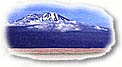 Tanzania
Tanzania's incredible Serengeti and Ngorongoro national parks are home to more game animals than anywhere in the world, and it is in Tanzania that we find the physical soul of Africa, the towering Mt. Kilimanjaro. Off Tanzania's coast, in the Indian Ocean, are the lush forests and poetic citadels of Zanzibar, an island which has changed little since its heyday as East Africa's primary gateway and trading post. 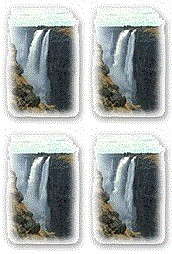 Zimbabwe
Zimbabwe is a wonderland of water. Once thought to be the mythic site of King Solomon's mines, Zimbabwe's real wealth can be found in the roaring splendor of Victoria Falls. Some of the world's best whitewater rafting on the Zambezi River

Location, Geography & Climate History & People Archaeologists have more recently determined that the site was occupied as early as the 3rd century AD, but that its ruins date from the12th to the 15th century. Known as Great Zimbabwe, it was during its heyday the capital of a Shona trading empire that collapsed for reasons that remain unknown. By the middle of the19th century, with European influence still slight, the region's Shona states had been defeated by an invading Ndebele army from the south. Ndebele power didn't last long, however. In 1890, the fortune-hunting Cecil Rhodes arrived at the head of a private army of settlers and commenced to conquer what he thought might be a rich gold-producing region. By 1897 the area had been completely subdued. In 1923 Rhodesia became a self-governing British colony, completely controlled by the white settlers. For much of the last half-century Zimbabwe's history has been that of the long struggle to end white rule. Finally, in 1979, a new constitution that provided for democratic majority rule was established. The country has in recent years moved increasingly toward a more liberal economy, and the era of violent internal strife appears to have concluded.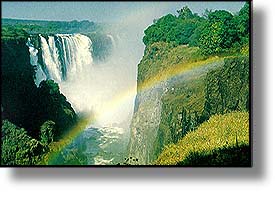 Zimbabwe, like Botswana, is a landlocked country at the base of the African continent. Its neighbours are Mozambique (to the east), South Africa and Botswana (to the south and west), and Zambia (to the north). Zimbabwe lies on a high plateau, and its terrain consists primarily of grasslands bordered on the east by mountains. The northeastern border of the country is marked by the mighty Zambezi River, along which is located the incomparable spectacle of Victoria Falls and the magnificent expanse of Lake Kariba. The Zambezi has become one of the world's best water adventure travel destinations, offering outstanding whitewater rafting in the Zambezi Gorges below the falls as well as excellent canoeing and kayaking above them.
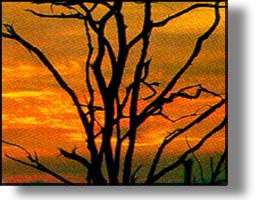 There is evidence of settlements in Zimbabwe dating from as long ago as the second century AD, but these early inhabitants were supplanted around the 5th century by Bantu-speaking peoples. In southeastern Zimbabwe, in 1870, European explorers came upon an impressive ruined city, which they believed to be the biblical city of Ophir--the site of King Solomon's mines. The immediate result was a frantic, and utterly unsuccessful, search for gold deposits in the surrounding region.
Location, Geography, & Climate South Africa is located, as one might expect, on the southern tip of Africa. It is bordered by the Atlantic Ocean on the west, the Indian Ocean on the south and east. Along its northern border, from west to east, lie Namibia, Botswana, and Zimbabwe, and to the northeast are Mozambique and Swaziland. Wholly-enclosed by South Africa, and situated in its eastern central plain, is the independent kingdom of Lesotho. Almost all of South Africa's 472,000 square miles (1.2 million sq. km.) lie below the Tropic of Capricorn, and the country is geographically composed of three primary regions: an expansive central plateau, a nearly continuous escarpment of mountain ranges that ring the plateau on the west, south, and east, and a narrow strip of low-lying land along the coast. Most of the central plateau (and most of the country) consists of high (4,000-6,000 ft/1,220-1,830 m), rolling grassland known as highveld. The highest points of the mountainous escarpment are found in the stunning Drakensberg (dragon's back) Mountains, where the tips of dragon's back can exceed heights of 10,000 ft (3,050 m). In the northwest, South Africa's Kalahari Gemsbok National Park, one of the continent's largest game reserves, extends into the red sands and scrub grasslands of the great Kalahari Desert. In the northeast, the highveld plateau descends to the Bushveld and Limpopo River basins. The Bushveld comprises South Africa's extensive savanna, in which is found the country's marvelously rich and diverse game reserve, the world-renowned Kruger National Park. Although South Africa's climate varies considerably across its various regions and environments, temperatures remain comfortable throughout the year. The best time to visit for safari is between May to August, when there is less rain and much less dense vegetation, making animal sightings far more frequent. History & People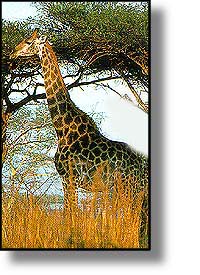 South Africa is one of the most geographically varied countries of the African continent, comprising territory that ranges from the rolling, fertile plains of the highveld and the wide open savanna of the Eastern Transvaal to the Kalahari desert and the peaks of the Drakensberg Mountains. While all of its diverse regions offer ample opportunities for adventure travel, the focus in South Africa--as in much of sub-Saharan Africa--is the safari. In addition to possessing two of the world's most renowned wildlife reserves, the Kruger and the Kalahari Gemsbok National Parks, the country contains over a dozen smaller regional parks and reserves. In addition, with its excellent road and rail systems, its abundance of top-rated accommodations, and its bountiful farmlands and vineyards, South Africa allows visitors ample opportunity for more luxurious comfort along with adventuresome excitement.
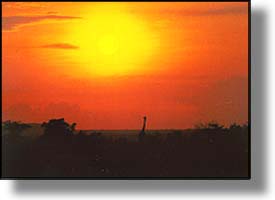 South Africa's population of forty million is three-quarters black (African) and about 15% white (European), with the remaining 10% comprised of people of mixed white, Malayan, and black descent and people of Asian (mostly Indian) descent. The African majority is composed of many different ethnic groups, the largest of which are Zulu, Xhosa, Tswana, and Bapedi. Until very recently, the country's racial divisions were harshly enforced as part of the government's official policy of Apartheid, or apartness. Although the government began to dismantle apartheid in 1989 after prolonged resistance, protest, and international economic sanctions, racial inequality remains pronounced in South Africa.
Introduction Namibia has four primary geographic regions, all of which are of great interest to the adventure traveller. In the north lies the Etosha Pan, an enormous alluvial basin that has long since lost the lake that it once held. Although water supplies are now limited for most of the year to the perimeter of the pan, the area remains sufficiently fertile to support great herds of antelope species (including gemsbok, impala, and springbok), zebra, and--most famously--elephants. Many other species of wildlife abound as well, and the Etosha Pan is now the center of one of the finest game parks on the African continent. In the northeast, Namibian territory extends between Angola and Botswana along the slender corridor of the Caprivi Strip. Unlike most of the rest of Namibia, the Caprivi Strip is a wooded and fertile region, and it is crossed by a number of rivers. Two of these, the Zambezi and the Okavango, rank among the great rivers of Africa. The strip is also the site of several game parks, which while not offering such an abundance of wildife certainly provide spectacular scenery and relative solitude. Namibia's center is occupied by a high escarpment plain. Windhoek, the capital and the only city of any size, is located smack dab in the middle of the country. In the northern part of the central plain is the Waterberg Plateau, a 150 sq. mi. (400 sq. km) shelf that rises 150 metres straight from the surrounding plain. The plateau is well-watered and lush, and is home to several rare and endangered species. At Namibia's southern tip is yet another geological wonder--the immense Fish River Canyon. Second only to the Grand Canyon in size, Fish River Canyon offers magnificent vistas and great--though strenuous--hiking. Daytime heat, rather than rain, is the primary concern for most travellers to Namibia. While temperatures are generally comfortable year round, the warmest season is the period extending from November to March. History & People Namibia is populated by few people, but those few constitute an unusually diverse set of peoples and cultures. The country's predominant (85%) black population is composed of several different ethnic groups, including the San, the Khoi-Khoi, the Herero, and the Ovambo. The small European population is composed of Germans and Afrikaners, and there is also a significant Asian minority. The great majority of Namibia's 1.5 million people live in the north, where there the climate is less arid and generally more hospitable. The history of habitation in Namibia begins with the San, who were living there at least two thousand years ago. As a nation, however, Namibia is relatively young, having gained its independence after prolonged struggles only in march of 1990. The country was largely spared the attentions of the European powers until the end of the nineteenth century, when it came under the control of Germany. In 1920 the territory was awarded by the League of Nations to South Africa, which resisted Namibian independence for decades as a result of the area's enormous mineral wealth. Although the UN voted to end South African control in 1966, widespread regional warfare prevented the establishment of an independent government for almost two decades.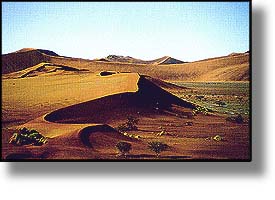 Namibia is a technicolor dreamscape, a land of swirling apricot dunes and shimmering white flats, mirages and dust devils, black-faced impala and crimson-breasted shrike. Its major game park, which centers on the Great Etosha Pan, offers an exceptional range and abundance of wildlife and a landscape that could not provide a more striking backdrop for it. The coastal region is one of the world's most captivating desert regions, and in the south lies a canyon second in magnificence only to the Grand Canyon itself.
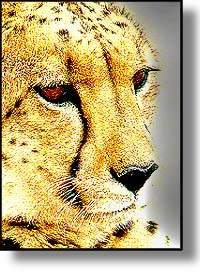 Along the Namibian coast lies the Namib Desert, a spectacularly barren, brilliant red sand landscape that is divided into the Skeleton Coast (in the north) and the Diamond Coast (in the south). There are a number of features of this coastal desert that make it quite unlike any spot on earth. First, and most famously, it is the richest source of diamonds on the planet, and Namibia is as a result the world's largest diamond producer. Second, the dry and hot Namibian shoreline is situated right at the point where the icy waters of the Atlantic hit the continent--Antarctic water meets African desert, and the result is often unbelievable fog. This highly mysterious coast is now the site of the 19,000 sq. mile (49,000 sq. km) Namib-Naukluft National Park, a
Although it cannot compete with the major safari countries for sheer natural spectacle, Mali is a nation of unusual interest and charm. Like Egypt, Mali is a country that is intimately related to a great river--in this case, the Niger. In addition, Mali is the location of some of the continent's most interesting cultural sites. Legendary Timbuktu is located here, and in the center of the country is the magnificently dramatic Bandiagara escarpment, home to the fascinating culture of the Dogon. Location, Geography & Climate Mali is shaped a bit like a butterfly, leaning to the northwest, with a much smaller left than right wing. The larger northwestern region of the country, which extends into the Sahara, is almost entirely arid desert or semidesert. In the central region, known as the Sahel, life follows the Niger River's annual flood cycle, with high water between August and November. In the southwestern area, rainfall and rivers are more plentiful, and this region is marginally more lush than the rest of the country. Mali's single most important geographic feature is undoubtedly the great Niger River, which traverses both the Sahel and the southeastern section of the country. The Niger, like the Nile, is both a critical source of sustenance and a major transportation artery--and in this latter capacity it is an excellent venue for boat travel. Although most of Mali experiences only negligible rainfall, the 'rainy' season in the south extends from June through September. History & People Although Mali is today one of the poorest countries in the world, it has a long and illustrious past as an integral part of great African empires. The first of these empires was the empire of Ghana, which from the 4th to the 11th century controlled the trans-Saharan caravan routes. Ghana fell under invasions by the Muslim Almoravids, but it was soon supplanted by a the Mandinka empire of Mali. Mali reached its pinnacle of power and wealth during the 14th century, extending over almost all of West Africa and controlling virtually all of the rich trans-Saharan gold trade. It was during this period that Mali's great cities, Timbuktu and Djenne, became fabled centers of wealth, learning, and culture. Mali's power didn't last much longer. In the 15th century it fell to the Songhai, who had established their own capital at Gao. The Songhai held sway until the end of the 16th century, their empire collapsed under both internal and external pressures. The end of the Songhai empire also marked the conclusion of the regions history as a trading centre, for the trans-Saharan trade routes quickly lost their vitality after the establishment of sea routes by Europeans. In the late nineteenth century, Mali became a French colony, and in 1960 it became independent. The country has suffered from periods of internal and external strife, as well as from an extended drought in the early 1970s, but today it appears to by moving toward a stable, multi-party democratic government. Mali's population comprises a number of different peoples, including the Bambara (who are the largest single segment), the Songhai, Mandinka, Senoufo, Fula, and Dogon. The last of these groups, the Dogon, are world-renowned for their artwork, and a visit to their traditional cliffside villages is a fascinating experience. The majority of Mali's people are Muslim, and the official language is French. Bambara, however, is the country's true lingua franca.Mali, the largest country in West Africa, is bordered by seven other states: Algeria lies to the north and northeast, Niger to the east, Burkina Faso to the southeast and, with the Ivory Coast, to the south. On the west are Senegal and Mauritania.
Location, Geography & Climate Kenya is situated right along the equator, on the eastern coast of the African continent. Its coastal region is on the southeast, and to the east lies Somalia. Ethiopia is to the north, the Sudan to the northwest, and Uganda directly to the west. The southwestern border of the country is marked by Lake Victoria, and southward lies Tanzania. Kenya's geography is marvelously varied. While much of northeastern Kenya is a flat, bush-covered plain, the remainder of the country encompasses pristine beaches, scenic highlands and lake regions, the Great Rift Valley, and the magnificent Mount Kenya. Although Kenya's varied environments experience a wide variety of climate conditions, the temperature remains comfortably warm year-round. Much of Kenya experiences heavy rainfall from March through May and, to a lesser extent, from October through December. The best time for most outdoor acitivities (including safari and mountain climbing) is during the dry season (June-September). History & People With the arrival of the Portuguese at the end of the 15th century, the East African coastal region was for a time dominated by the Europeans. However, in 1729 the Portuguese were expelled, to be replaced by two Arab dynasties. Arab rule lasted until the end of the 18th century, when Kenya passed into the British sphere of influence. The country became independent in 1963. Although it has experienced its share of internal and external strife, Kenya has in recent years been moving toward a more stable, multi-party political system. Kenya's population is overwhelmingly (97%) comprised of people of African descent, though that group is composed of over 70 different tribal groups. Among the most significant are the Kikuyu, Kamba, Gusii, Luhya, and Luo. Kenya's primary languages are English and Swahili, though regional tribal languages abound.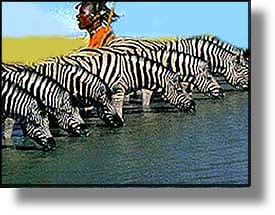 Kenya is still the primary focus of all adventure travel in Africa. It is one of the finest--and undoubtedly the most famous--safari destination in the world. Safari, however, is by no means the only reason to visit Kenya, for the attractions of its rich culture and diverse environments are considerable.
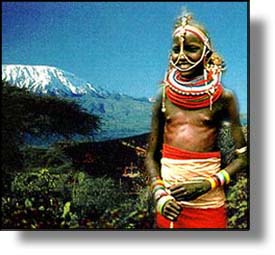 Kenya has known the presence of humankind since the very earliest development of our species. Moreover, the region has long been a migratory path, passed through by wave upon wave of peoples from all over Africa and, later, from the Middle East as well. By the 10th century or so, the region had developed its own lingua franca, Swahili, which is a Bantu language heavily overlaid with Arabic. Among other familiar words, safari is Swahili, meaning simply travel.
Location, Geography & Climate Much of the attraction of Ghana is based upon its legacy as the center of the gold, ivory, and slave trade during the 17th and 18th centuries, when the mighty Ashanti empire held sway here. However, Ghana also possesses one of the best game reserves in West Africa, a multitude of good beaches, and plenty of hospitality. Ghana's distinguishing geographic feature is the Volta River, on which was built the Akosombo dam in 1964. The damming of the Volta created the enormous Lake Volta, which occupies a sizeable portion of Ghana's southeastern territory. Lake Volta is also the site of Kujani National Park, though Ghana's best-known park is Mole, located in the north. Unfortunately, neither Lake Volta nor the river itself have yet been developed for touring--although lake cruises are offered, the great majority of water traffic consists of cargo ships. Rainfall is fairly heavy, particularly from April through September. History & People Ghana's rich history centers on the once-great Ashanti empire, which rose to power during the late 17th century and continued to prosper as a center of the 18th century slave trade. The Ashanti capital, Kumasi, was during this period one of the finest and most advanced cities in Africa, and the Ashanti state even employed significant numbers of Europeans as advisors and administrators. The European presence in Ghana is also marked by the multitude of colonial forts that dot its coastline--strongholds that anchored the European trade in gold, ivory, and slaves. Although Ghana, then known as the Gold Coast, was largely considered a British territory by the latter half of the 19th century, it wasn't until 1900 that the British succeeded in defeating the Ashanti and the area's other strong kingdoms. More on the Ashanti If Ghana was late in coming under European control, it was also the first African nation to win back its independence, in 1957. However, corruption and internal military strife proved to be apparently intractable problems, and Ghana went through an extended period of instability in the 1960s and 1970s marked by military rule. The country has been since then been moving steadily toward political stability and economic prosperity, and seems today to possess one of the most promising futures of any of the West African nations. Most of Ghana's 17 million people practice either Christianity or Islam, which are prevalent depending on the region. Christianity prospers in the south, while Islam dominates the rural north. Local religions also endure in Ghana, and are often practiced syncreticaly with the mainstream religions. The country's main holiday, Akwasidee, comes from the Ashanti religious calendar, and features an ornate ceremony involving the Ashanti king, known as the Asantehene.Ghana is one of the five African nations along the northern coastline of the Gulf of Guinea. It is bordered on the west by Cote d'Ivoire, on the north by Burkina Faso, and on the east by Togo. The country consists mostly of low-lying savannah regions, with a central belt of forest.
Botswana is one of the few remaining destinations in Africa that still provides a good sense of the adventure of safari. Its expansive game parks and preserves, while offering wildlife as diverse and abundant as that found anywhere else, are still largely undeveloped and untamed. Location, Geography & Climate Nearby is Chobe National Park, a beautiful grassland reserve that has gained international fame for its abundant elephant population. Southeast of Chobe are Botswana's enormous Makgadikgadi salt pans, home to large herds of blue wildebeest, several antelope species, and those international lovers of salt pans, flamingos. Almost the entire remaining portion of the country is covered by the Kalahari Desert--a varied environment of sand, savanna, and grassland. Although this area of Botswana is only sparsely inhabited by humans, it is one of the richest wildlife regions in all of Africa. Botswana's two largest parks, the Central Kalahari Game reserve and Gemsbok National Park, are found in this region. Botswana's climate can get rather cool, particularly during the dry winter months of June-August when night occasionally brings frost. The rainy summer months (December through March) are best avoided for those interested in enjoying the best game viewing conditions. History & People The discovery of gold in Botswana in the late 19th century attracted the interest of the Boers, leading the fiercely independent but desperate Tswana nations to petition the British for protection. Botswana was granted protectorate status (as Bechuanaland) in 1885, though local authority was maintained with determination by the Tswana chiefs. In 1966, in the same wave of change that brought independence to much of the continent, Bechuanaland became the independent Republic of Botswana. The very next year, the discovery of enormous diamond reserves in Botswana transformed the poor country's economic prospects. Today it enjoys one of the highest economic growth rates of any country in the world, although its national wealth has not solved the problem of widespread unemployment. Botswana lies immediately to the north of South Africa. It is bordered on the north and west by Namibia, on the north and east by Zimbabwe, and is connected by a narrow strip of land on the northern border to Zambia. Its territory consists almost entirely of a broad, flat, arid subtropical plateau, though there are hills in the eastern part of the country.
In the northwest, the Okavango River empties into the Kalahari sands, creating the largest inland river delta in the world. While the Okavango Delta is home to relatively few large game animals in comparison to other areas of Botswana, its clear waters and myriad small islands are home to an astounding variety of birds, plants, and smaller species of animals.  The aboriginal inhabitants of Botswana, who have made the Kalahari their home for at least 30,000 years, are the San, or bushmen. The San number about 60,000 today, constituting a small but fascinating cultural minority in the country. Almost two millennia ago, a Bantu people known as the Tswana arrived, supplanting the San and now constituting the great majority of the population.
Try the following 5 diet tips and lifestyle modifications to gain weight and achieve your goal -
For example you can choose all the full fat dairy products as they will also provide proteins and other nutrients along with the possible fat in the diet. But say a strict NO to junk foods, processed and excess oily foods. These foods will be very attractive way to gain weight but once you develop any wrong eating habits then it will be difficult to get away with.

A number of diet tips are available, out of which ten diet tips are listed below. These top 10 diet tips help in promotion of healthy eating pattern with a disease-free life. Certain guidelines to prevent extra fat and ensure healthy living remain the same. A balanced diet helps in weight loss. It also helps in maintenance of body weight. Eating at home is the best way to healthy eating.
Eating at home ensures a nutritious diet with no unwanted fat. It is more reliable, as food is prepared with great hygiene. Take a look at these top ten diet tips!
- Healthy fats are the best way to prevent any health complications. Saturated fats and Trans fats are better avoided. Butter, clarified butter, margarine and hydrogenated fats are some of them. Plant oils, such as sunflower, safflower, olive, groundnut and soya bean oil prove beneficial.
Fish oil also helps, as they provide the necessary omega 3 fatty acids. - Plants in their natural form contribute to phyto nutrients, antioxidants, minerals and vitamins. Fresh fruits and raw vegetables are preferred in the raw or slightly cooked form. The pH levels are balanced.
- Adequate amount of water helps in keeping the body hydrated. Eight to ten glasses of water are recommended on a daily basis. Fruit juices and clear soups also provide water. Carbonated beverages or fizzy drinks are completely abstained form as they result in 'empty calories'. No other nutrients are acquired through these beverages.
- Eating often helps to a considerable extent, provided, the meal size is small. Five or six meals are preferred instead of three large meals. It is also advisable to have three meals with three snacks
- Drastic reduction of calories is not recommended, as it might backfire and result in overeating. Skipping breakfast is not ideal. Feasting or fasting is hazardous to health.
- Eating amnesia or forgetting what you have eaten is common, especially while eating in front of the television. Our stomach is equal to the size of our fist. Does it mean we are overeating to a very great degree? Avoid eating from the wrapper or packet or container as we have no idea about our food intake.
- Feeling of satiety pops in much after you have finished eating, which means that the chances of over eating are highly present. At the end of the meal, you should feel fine. You should not feel tired, over stuffed or bloated and ready to burst. Reasonable portion sizes prove helpful in understanding your stomach's signal.
- Avoid cutting down foods of your choices. It is difficult to stop your likes, all of a sudden. Limit your cravings by decreasing the size of the preferred food.
- Avoid eating out. When forced to, order half of what you need. Foods in restaurants are loaded with fat and calories. Using smaller plates is a way to trick others and your mind.
- Fill your kitchen pantry with healthy foods. Avoid processed and junk foods.
Eat well and enjoy life to the fullest!!!
Keep your workforce more secure, managed, and mobile. With security and manageability built right onto the chip, Intel® Centrino® 2 with vPro™ technology provides hardware-assisted remote isolation, diagnostics, and repair, so you can manage your mobile workforce remotely, even if the system's OS is unresponsive.¹ And with exceptional dual-core performance, 5X better wireless performanceΩ and the longest possible battery life.² Now you can also get notebooks with Intel Centrino 2 with vPro technology in astonishingly thin and light packages. As the smallest version of Intel® Centrino® processor technology yet-50 percent smaller-you're most mobile workforce can enjoy the sleekest full-featured and performance packed notebooks³ along with improved energy efficiency and power savings.° Best for business, providing state-of-the-art threat protection against security threats enabled by hardware defense filters and agent presence checking.Φ Mobile performance. Providing the next level of mobile performance,Δ new Intel Centrino 2 with vPro technology is designed for today's needs, future 64-bit applications,² and next-generation multithreaded software. Increased energy-efficiency. Built on the latest 45nm Intel® Core™ microarchitecture, Intel Centrino 2 with vPro technology provides industry-leading,² energy-efficient performance. Explore the good, the better, and the best of the Intel® Enterprise technologies. Longer battery life. Based on next-generation hafnium-based 45nm technology, Intel Centrino 2 with vPro technology offers unique energy-saving components designed to give you the longest possible battery life. Faster, more predictable wireless. Experience up to 5x faster connectivity speeds with 802.11n wireless technology improving reliability while decreasing connection loss.Ω Manage your mobile workforce wirelessly. Remotely diagnose, isolate, and repair infected notebooks using hardware-based remote manageability features that work even if notebooks are off or the OS is unresponsive.¹ Broad industry support from leading manageability and security software providers like Symantec, LANDesk, HP, Microsoft, and Cisco. Reduce maintenance costs and stay compliant. Provide routine patching and maintenance ensuring that you're only paying software license fees for what you're using while keeping your licenses up-to-date.¹ Get the most out of graphics-intensive Windows Vista*. Powerful Intel® Graphics allow you to run Windows Vista with full Aero* support-without the expense of an additional graphics card.²
Features and benefits
Intel® Enterprise Technologies
With faster, intelligent, multi-core technology that applies processing power where it's needed most, new Intel® Core™ i7 processors deliver an incredible breakthrough in PC performance. They are the best desktop processors on the planet.¹ You'll multitask applications faster and unleash incredible digital media creation. And you'll experience maximum performance for everything you do, thanks to the combination of Intel® Turbo Boost technology² and Intel® Hyper-Threading technology (Intel® HT technology)³, which maximizes performance to match your workload. Intel Core i7 processors deliver an incredible breakthrough in quad-core performance and feature the latest innovations in processor technologies: Intel® Turbo Boost technology maximizes speed for demanding applications, dynamically accelerating performance to match your workload—more performance when you need it the most.² Intel® Hyper-Threading technology enables highly threaded applications to get more work done in parallel. With 8 threads available to the operating system, multi-tasking becomes even easier.³ Intel® Smart Cache provides a higher-performance, more efficient cache subsystem. Optimized for industry leading multi-threaded games. Intel® QuickPath Interconnect is designed for increased bandwidth and low latency. It can achieve data transfer speeds as high as 25.6 GB/sec with the Extreme Edition processor. Integrated memory controller enables three channels of DDR3 1066 MHz memory, resulting in up to 25.6 GB/sec memory bandwidth. This memory controller's lower latency and higher memory bandwidth delivers amazing performance for data-intensive applications. Intel® HD Boost significantly improves a broad range of multimedia and compute-intensive applications. The 128-bit SSE instructions are issued at a throughput rate of one per clock cycle, allowing a new level of processing efficiency with SSE4 optimized applications. Δ Intel® processor numbers are not a measure of performance. Processor numbers differentiate features within each processor family, not across different processor families. Seewww.intel.com/products/processor_number/ for details. ¹ Performance based on select industry benchmarks, game titles, and multimedia creation applications. Actual performance may vary. See www.intel.com/performance/desktop/extreme/ for additional information. ² Intel® Turbo Boost technology requires a PC with a processor with Intel Turbo Boost capability. Intel Turbo Boost performance varies depending on hardware, software and overall system configuration. Check with your PC manufacturer on whether your system delivers Intel Turbo Boost technology. See www.intel.com/technology/turboboost for more information. ³ Intel® Hyper-Threading technology (Intel® HT technology) requires a computer system with a processor supporting Intel HT Technology and an Intel HT technology-enabled chipset, BIOS, and operating system. Performance will vary depending on the specific hardware and software you use. For more information including details on which processors support Intel HT technology, seewww.intel.com/info/hyperthreading.The best desktop processors on the planet¹

Brilliantly fast
Product information
Features and benefits
Go to the next level of multi-core performance.
(1) If your plan is to get lean muscle mass, just doing weight-free exercises like push ups, pull ups, dips, leg raises, squats and calf raises will help you achieve your objectives. Below is a list of the muscle groups these exercises target. Push Ups: Chest, triceps and shoulders If you don't know how these exercises are performed, just make a search on Google for instance and you will get more details. On the other hand, if you are targeting for bigger muscles, it's better to lift weights for hard muscle mass. For every exercise set, go for 6-10 repeats and try to lift weights where you can do between these number of repeats. This means you will lift heavy and as a result, you'll get bigger and stronger muscles. Exercises like bench press, barbell rows, barbell curls, triceps extensions, military press, deadlifts and squats are good for hard muscle mass. (2) Don't overtrain. For example, don't work a body part everyday because it won't grow. Your muscles need recovery and rest to grow because after every workout, your muscle tissues are depleted. If you're training with weights, you can do a full workout on a particular muscle group once a week and train to failure meaning to total exhaustion. If you're training weight-free, twice a week should be fine. Remember, your muscles grow when you're resting not when you're training. Also, avoid working on a muscle group if it's still sore because this can lead to injury. (3) Consistency is key for muscle gains. If you plan to train twice this week and then the next week once only, then 3 times the following week, your progress will be really slow. Stick to a plan for at least 1 month and see how it goes. Train about 3-4 times a week and don't miss any workout. (4) Have a proper diet and eat healthy food. Eat reasonable amount of carbohydrates, protein and fats at each meal. Some good sources of carbohydrates are potatoes, yams, sweet potatoes, oatmeal, wholewheat pasta, wholemeal bread, brown rice. For protein, some good sources are skinless chicken or turkey breast, fish, tuna, salmon, egg whites, skim milk, cottage cheese, baked beans, red lentils, peanuts and lean red meat. For fats, opt for unsaturated fats like virgin olive oil, flaxseed oil and fish oils and avoid animal fats which are saturated ones. (5) Eat vegetables and fruits because this will balance your diet. These are good for your health as well. Some good sources of vegetables are broccoli, green beans, cauliflower, tomato and for fruits, you have banana, orange, peach, grape, apple amongst others. (6) Eat regularly and avoid keeping your body without food for more than 3 hours unless you're sleeping. You should eat preferably 4-6 times per day in moderate amounts every 2-3 hours as this keeps your metabolism high. Eating only 1-3 meals per day slows your metabolism down. Don't skip breakfast as this meal will ensure you have energy before starting your day. Just remember, if you want to get big, you need to eat big but you have to eat clean and not just anything. You need to eat more calories than you usually do to bulk up. (7) Drink water before, during and after each workout as the latter helps maintain muscle mass. Also it's important to hydrate yourself because you're perspiring when exercising. Drink at least 1.5 litres of water per day. The more the better. (8) Eat sufficient amount of carbohydrates a few hours before exercising because your body needs energy for your workout. Never exercise on an empty stomach. Your body needs "fuel" for your workouts and depriving it from this important element in your training will hinder your muscle gains. When your body doesn't have sufficient amount of energy, it will break down on your muscle tissues and you'll lose muscle mass. (9) Get adequate amount of sleep every night, at least 8 hours of quality sleep. Your body needs recovery after working out and in order for it to grow, it needs sufficient amount of rest. Also, proper form is important when exercising to get maximum gains. (10) Do some cardio like jogging, swimming, aerobics, bicycling as this will burn fat and make your body more muscular. Building muscle mass is a long term goal and if you don't see results when you're just starting out, don't get discouraged because it takes some time to get results. Follow the 10 tips above, keep at it and you should progress with time. Good luck in your muscle mass building goals.
Pull Ups: Back, biceps and forearms
Dips: Triceps, chest and shoulders
Leg Raises: Abdominals
Squats: Legs
Calf Raises: Calves